luni, 4 septembrie 2017

Off Topic - Architectural visions of the United Nations


1/08/1946
The site of new UN Headquarters as it looked in August 1946, about one month after the demolition work had began. General view, looking south, of the Manhattan site of the United Nations permanent headquarters, at an early stage of demolition work. East River is at left, First Avenue at right.
The decision to locate the United Nations in New York City was made in London by the General Assembly at its first session on 14 February 1946, after offers and suggestions for permanent sites had been received from many parts of the world. An offer by John D. Rockefeller, Jr. was accepted by a large majority of the General Assembly on 14 December 1946. New York City completed the site parcel by additional gifts of property. The site chosen by the United Nations was a run-down area of slaughterhouses, light industry and a railroad barge landing. A $65 million plan for the construction of the site was approved by the General Assembly on 20 November 1947. To finance construction, the US Government made an interest-free loan of $65 million to the UN. This amount had been repaid by 1982.

 
21/12/1948
New scale model of the proposed permanent Headquartersof the United Nations. Designed by the Board of Design Consultants of the United Nations Headquarters Planning Office, the model of the future seat of the United Nations to be erected on the Manhattan East River site was approved by the General Assembly.

 
06/08/1947
Charles Le Corbusier, France, Architect on the 10-member Board of Design Consultants assisting Wallace K. Harrison, Director of Planning in the development of architectural plans for the building of United Nations permanent Headquarters on the East River site, at microphone, recording broadcast.


Date: 01/04/1947
Wallace K. Harrison, fourth from left in background, Chief Planner for United Nations Headquarters, pictured before the preliminary models with members of the 10-man Board of Design Consultants and other consultants appointed to assist him in drawing up plans for the construction of UN Permanent Headquarters on the Manhattan East River site. Board members standing in foreground are, left to right: Ssu-Cheng Liang, China; Oscar Niemeyer, Brazil; Nikolai Bassov, USSR; and Ernest Cormier, Canada. In second row, from left to right: Sven Markelius, Sweden; Charles Le Corbusier, France; Board Member Bodiansky, France, engineer, consultant to Director; Mr. Harrison; G.A. Foilleux, Ausralian Board Member; Max Abramowitz, United States; Director of Planning and consultants Ernest Weismann, Yugoslavia; Antoniades, Greece, and Matthew Nowicki, Poland. [RKO Building]. April 1947.
 

24/10/1949
Cornerstone Laying Ceremony Marks United Nations' Fourth Birthday
The cornerstone of the United Nations Permanent Headquarters was laid on United Nations Day, 24 October, at a special open-air General Assembly meeting held on the site of the Headquarters building in Manhattan, New York. The ceremony, marking the Fourth Anniversary of the United Nations, was attended by President Harry S. Truman who was the principal speaker. Secretary-General Trygve Lie deposited in the stone copies of the United Nations Charter and of the Universal Declaration of Human Rights.


24/10/1949
Cornerstone Laying Ceremony Marks United Nations' Fourth Birthday
General view of public attending the ceremony.


24/10/1949
Cornerstone Laying Ceremony Marks United Nations' Fourth Birthday
General view of public attending the ceremony.


08/07/1947
Demolition Begins on United Nations Permanent Headquarters
During brief ceremony at which demolition of present structures on the United Nations Permanent site was begun, Byron Price, United States, Assistant Secretary-General for Administrative and Financial Services, extreme left, Hugo Rogers, center, Manhattan Borough President, and William O'Dwyer, Mayor of the City of New York, remove the first dozen bricks from a boarded up five-story tenement building.
 

03/05/1947
UN Headquarters Planning Office. Architects model #23-A.


01/01/1946
Interim Headquarters of the United Nations
 Exterior view or the Central Hall, London, site of the first part of the First Session of the United Nations General Assembly. The Assembly held its first meeting on January 10, 1946.


24/11/1949
Pinch and Punch...by HAP
News Item: New United nations Headquarters building to be equipped with more than 2,000 individual air conditioning units to protect health of workers recruited form widely different climatic and temperature zones.
Punch: I hear they can't even get together on the temperature they want in there...
Pinch: What's the difference - so long as they figure out some way to keep on working in the same building?
 

02/09/1950
Model for the Economic and Social Chamber
Mr. Sven Markelius (extreme left), well know Swedish architect, presents his suggestion for the Economic and Social Chamber at the new U.N. Headquarters to (l. to r.): Mr. Wallace Harrison, of U. S.A., Mr. Jacques Carlu, of France, and Mr. Howard Robertson, of U.K., members of the U.N. Art Advisory Board. On this picture, the model is seen from the Gallery end, showing the large 'Window behind the Council table.


http://www.histecon.magd.cam.ac.uk/internationalhistory/architecture.htm


Vrem Nu Vrem......

10 May 1916 the Romanian National Day

The Romanian celebrations of National Day – 10 May 1916 – cavalry passing in review before King Ferdinand. Being in the nature of a military review the Romanian National Day celebrations were mainly of a warlike character. The war in which Europe was involved gave that year a wider significance than before. The celebrations were mainly in the nature of a ‘preparedness for war’ demonstration.

A mobile anti-aircraft battery in the Romanian demonstration.

Romania’s entry into the Great War, 27 August 1916. King Ferdinand’s Proclamation

In ziua de 14/27 august 1916, a avut loc Consiliul de Coroana care a decis intrarea României în Primul Razboi Mondial, alaturi de Antanta, într-o conventie politica si una militara. În aceeasi zi, România a declarat razboi Imperiului Austro-Ungar.

Consiliul de Coroana a avut loc la Palatul Cotroceni, în prezen?a Regelui Ferdinand I. La consiliu s-a decis mobilizarea generala. A doua zi, în seara de 15/28 spre 16/29 august, Capitala a fost atacata. Regina Maria si copiii s-au retras la Buftea, iar Regele Ferdinand cu Principele Carol la Scrovistea.

 Romanians!

    The war which for the last two years has been encircling our frontiers more and more closely has shaken the ancient foundations of Europe to their depths.

    It has brought the day which has been awaited for centuries by the national conscience, by the founders of the Romanian State, by those who united the Principalities in the war of independence, by those responsible for the national renaissance.

    It is the day of the union of all branches of our nation.  Today we are able to complete the task of our forefathers and to establish forever that which Michael the Great was only able to establish for a moment, namely, a Romanian union on both slopes of the Carpathians.

    For us the mountains and plains of Bukowina, where Stephen the Great has slept for centuries.  In our moral energy and our valour lie the means of giving him back his birthright of a great and free Romania from the Tisza to the Black Sea, and to prosper in peace in accordance with our customs and our hopes and dreams.

    Romanians! Animated by the holy duty imposed upon us, and determined to bear manfully all the sacrifices inseparable from an arduous war, we will march into battle with the irresistible élan of a people firmly confident in its destiny.  The glorious fruits of victory shall be our reward. Forward, with the help of God!

FERDINAND I (28 August 1916)

27 August 1916: Following Romania’s war declaration on Austria-Hungary, Germany announced that she was also at war with Romania. Romania’s decision was reached at a meeting of the Crown Council, summoned by King Ferdinand.

First Scenes since the Declaration of War by King Ferdinand

The Crown Prince Carol talking to a group of veterans who fought for Romania in the Russo-Turkish War of 1877-78.

After the Declaration of War – the departure of a Romanian regiment for the front. The Crown Prince Carol of Romania (right, second) watches the men of a regiment of infantry proceeding on active service as they march through the streets on their way to the front.

The Queen of Romania & Prince Nicholas (r) visit a hospital in Bucharest.

The Metropolitan followed by his clergy, leaves the church after a solemn Te Deum for the victory of the Allies.

King Ferdinand of Romania October 1916

Members of King Ferdinand’s personal staff

The royal guards drawn up in front of the Scroviste residence. The letters, RF, figure on the shoulder straps of the tunic.

King Ferdinand of Romania driving from the Royal military headquarters, October 1916. The King acts as his own chauffeur when occasions arise. Beside him is Prince Carol. The car is of a powerful, for those times, touring type with external brake levers. Behind is the  pillared portico of the royal hunting lodge from Scroviste, near Bucharest. These are one of the first photographs of the monarch and his staff taken after Romania entered the First World War (August 1916).

Changing guard at the royal headquarters (October 1916)


Pictures and captions from  royalromania.wordpress.com. Thank You!

© CD1Inc!.com ® 2017
     

vineri, 25 august 2017

Un razboi nedortit

Un razboi nedortit

 Pentru a avea o intelegere cit mai mare a documentelor fotografice care vor fi prezentate in acest "Blog" voi incerca sa prezint situatia istorica inainte si in timpul razboiului, situatie care a fortat Romania sa intre in razboi.

Multumiri "Wikipedia" pentru "inspiratie".

Participarea României la Primul Război Mondial cuprinde totalitatea măsurilor și acțiunilor de ordin politic, diplomatic și militar desfășurate de statul român, singur sau împreună cu aliații, între 13/28 iulie 1914 și 28 ocotmbrie/11 noiembrie 1918, în vederea atingerii scopului politic principal al participării la război - realizarea statului național unitar român.

Din punct de vedere al statutului de beligeranță, România a fost pe rând: țară neutră în perioada 13/28 iulie 1914 - 14/27 august 1916, țară beligerantă de partea Antantei în perioada 14/27 august 1916 - 26 noiembrie/9 decembrie 1917, în stare de armistițiu în perioada 27 noiembrie/10 decembrie 1917 - 24 aprilie/7 mai 1918, țară necombatantă în perioada 24 aprilie/7 mai 1918 - 26 octombrie/9 noiembrie 1918, țară beligerantă de partea Antantei în perioada 26 ocotombrie/9 noiembrie 1918 - 28 octombrie/11 noiembrie 1918.

Sistemul internațional era marcat la sfârșitul secolului XIX și începutul secolului XX de rivalitatea dintre marile puteri pentru controlul lumii extraeuropene. În Europa, Germania devenise principala putere și comportamentul ei pe continent a determinat o extraordinară destrămare și recompunere a alianțelor în raport cu deceniile anterioare.

România era ea însăși prinsă în aceste jocuri de putere. Pe de o parte ea era un obiect al rivalităților imperiilor vecine, care aveau pregătite planuri anexioniste pentru diferite părți ale teritoriului său, pe de altă parte România căuta să își creeze condițiile propice pentru îndeplinirea idealului național, de adunare într-un singur stat a tuturor provinciilor istorice românești.

Din punct de vedere militar, România venea după o victorie fără glorie în Al Doilea Război Balcanic, euforia victoriei făcând să se treacă cu ușurință peste lipsurile manifestate în domeniul conducerii militare, organizării și instruirii trupelor și mai ales a înzestrării cu armament și tehnică de luptă moderne.

Deși legată de Imperiul Austro-Ungar printr-un tratat secret de alianță, din 1883, România alege să se declare neutră la izbucnirea ostilităților, în iulie 1914, prevalându-se de interpretarea clauzelor relative la „casus foederis”. În anii neutralității, guvernul liberal condus de Ion I.C. Brătianu a adoptat o atitudine de expectativă, în ciuda faptului că toate părțile implicate în conflict au făcut presiuni asupra României combinate cu promisiuni, pentru a li se alătura.

În august 1916, România primește un ultimatum să decidă dacă dorește să se alăture Antantei „acum ori niciodată”. Sub presiunea cererii ultimative, guvernul român acceptă să intre în război de partea Antantei, deși situația de pe fronturile de luptă nu era una favorabilă.

După o serie de victorii tactice rapide în Transilvania asupra unor forțe austro-ungare copleșite din punct de vedere numeric, armata română va suferi în toamna anului 1916 o serie de înfrângeri zdrobitoare, ceea ce va forța autoritățile statului să se refugieze în Moldova, permițând inamicului să ocupe două treimi din teritoriul național, inclusiv capitala București. Cauzele principale ale înfrângerii Armatei României în campania anului 1916, de forțe germane și austro-ungare semnificativ inferioare numeric, au fost ingerințele politice majore în actul conducerii militare, incompetența, impostura și lașitatea unei părți semnificative a eșalonului militar de conducere, precum și lipsa de adecvare a pregătirii și dotării trupelor pentru tipul de război purtat.

În iarna lui 1916 și primăvara anului 1917, sub conducerea unui nou „leadership” militar (generalii Prezan, Christescu, Grigorescu, Averescu, Văitoianu etc.) și cu sprijinul substanțial al Misiunii Militare Franceze conduse de generalul Henri Berthelot, Armata României a fost reorganizată și instruită pe baze moderne adaptate cerințelor războiului.

Campania din vara anului 1917 a fost una de succes, reușindu-se, în faza inițială, înfrângerea trupelor Puterilor Centrale în bătăliile de la Mărăști, Oituz și Mărășești. Planificatorii militari români intenționau ca în continuare să dezvolte această ofensivă pentru a începe eliberarea teritoriului ocupat, dar izbucnirea revoluției în Imperiul Rus a dus la abandonarea acestor planuri și trecerea din nou la defensiva strategică.

Situația pe frontul de est a evoluat într-un mod negativ, astfel încât după ce Rusia a încheiat pacea de la Brest-Litovsk cu Puterile Centrale, România a fost nevoită să ceară armistițiul și apoi să fie nevoită să iasă din război și să semneze o pace separată în condiții umilitoare, în primăvara lui 1918. Refuzul regelui Ferdinand, care a amânat la nesfârșit gestul formal de a semna acest tratat, a făcut posibilă reînceperea ostilităților în ultimele două zile ale războiului, prezervând în acest mod statutul României de stat beligerant la Conferința de Pace de la Paris.

 Footgrafiile urmatoare curtezie "Iperial War Museums" Am pastrat explicatiile originale in limba engleza.

The memorial erected on the spot where Archduke Franz Ferdinand of Austria-Hungary and his wife were assassinated during their visit to Sarajevo in 1914.
August 1916. Consulul Romaniei la Paris Mr. Lahovary Intra pe usa Consulatului Roman din Paris. Este ziua in care Romania a intrat in Primul Razboi Mondial
Kaiser Wilhelm II in conversation with a senior German officer while inspecting troops.
Romanian sailors manning an anti-aircraft gun on a monitor near Chilia Veche, 1917.
The Romanian tropedo boat "Zborul" near Izmail, 1917.
A Romanian machine gun position an a tree near Verdea, 1917.
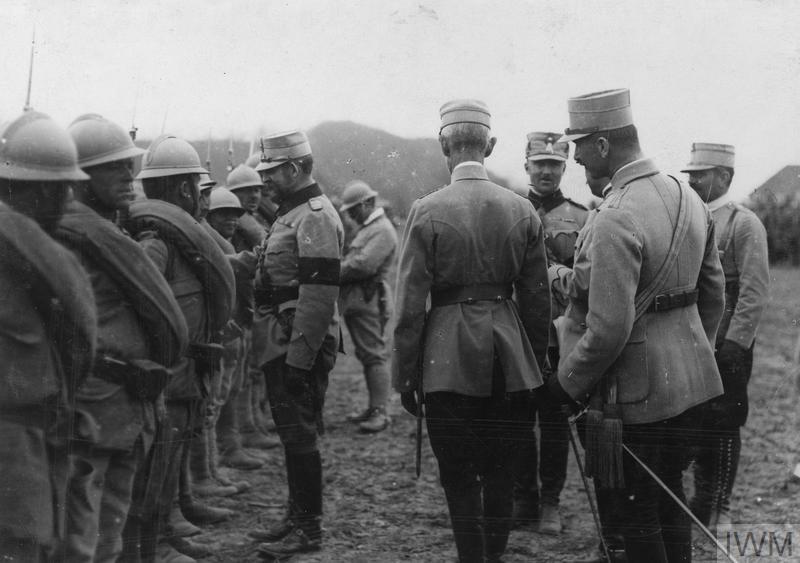
The King Ferdinand I of Romania speaks to the soldiers. Racaciuni, 1917.

Field Marshal August von Mackensen takin a morning ride in Bukarest during the peace preliminaries, May 1918.

Aviaţia Armatei în timpul războiului 1916-1918

Din Pacate nu cunosc provenienta fotografiilor.